

America’s Supersonic Comeback Takes Shape After Decades of Silence |
"The revival of supersonic travel in America signals a new era of speed and innovation - find out how it's happening now!" |
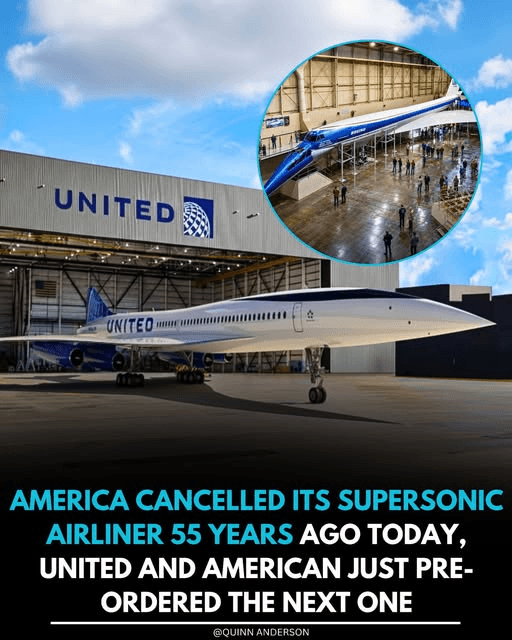
On May 20, 1971, the United States Senate delivered the final blow to Boeing’s 2707 Supersonic Transport, ending one of the most ambitious aviation programs in American history. The project had already consumed nearly $1 billion in federal funding and secured 115 orders from 25 airlines, including Pan Am, TWA, United, Delta, American, and Northwest. Designed to carry up to 300 passengers at speeds approaching Mach 3—far faster than the Concorde—two prototypes were already under construction in Seattle when the program was abruptly terminated. Neither would ever be completed, and the aircraft never flew. The fallout was immediate and severe. More than 60,000 Boeing employees lost their jobs, triggering a regional economic downturn across the Puget Sound area. The crisis became so well known that a now-famous billboard appeared near Seattle, reading: “Will the last person leaving Seattle please turn out the lights.” The failure of the 2707 was not due to a single issue, but a convergence of technical, environmental, and political challenges. Its complex swing-wing design proved too heavy and had to be abandoned during development. Engineers struggled to manage the extreme heat generated by sustained Mach 3 flight. Public opposition intensified after a 1964 sonic boom test over Oklahoma City shattered nearly 150 windows and sparked more than 15,000 complaints within six months. At the same time, environmental concerns—particularly regarding potential ozone damage—gained traction. Ultimately, Congress decided the investment was no longer justified, and in March 1971, the Senate voted 51–46 to cut funding. The House followed, and the program ended the same day the Concorde was already operating commercially. More than five decades later, the idea of American supersonic passenger travel is reemerging. American Airlines and United Airlines have both placed orders for Boom Supersonic’s Overture, a new aircraft designed to travel at Mach 1.7 while carrying between 64 and 80 passengers. Unlike its predecessor, Overture is built to meet modern noise standards and is intended primarily for overwater routes, where sonic boom restrictions are less limiting. It is a more modest vision than the 2707—slower, smaller, and more constrained. Yet the symbolism is striking: on the anniversary of the day the United States abandoned supersonic commercial flight, some of the very same airlines that once backed the 2707 are now investing in its potential successor. After 55 years, supersonic travel in America may finally be preparing for a return. |
0 Comments
Join the conversation
Be the first to comment
Share your thoughts above.